
Mold Inspection In
Vero Beach
Mold Shark runs licensed mold assessments across Vero Beach, from the barrier island to the mainland neighborhoods west of US-1. We inspect, map moisture, and sample when the conditions call for it, then hand you a written report you can give to a contractor, an adjuster, or a buyer. We do not perform remediation, so the findings are not a sales pitch for our own repair work.
Local Conditions
What Drives Moisture In Vero Beach.
Vero Beach splits into two different moisture problems, and which side of the causeways you are on changes what we look at first. On the barrier island, from Central Beach and Ocean Drive down through South Beach and north into Indian River Shores, salt spray works on window gaskets, slider tracks and exterior sealant joints faster than it does a few miles inland. Once a slider seal or a window perimeter gives up, wind-driven rain off the Atlantic gets behind the finish into the wall cavity, and the first thing an owner usually notices is a stain or a musty smell months after the water actually got in. On an oceanfront or near-ocean property, sliders and window returns get the moisture meter before anything else.
The mid-rise and high-rise condo buildings on the island behave nothing like a single-family house. Warm humid air rises through shafts, stairwells and corridor pressure differences and pushes into unit cavities, chases and closets, which means a damp closet in one unit is often tied to how the whole building is running rather than to anything that unit did. That is why HOA common areas, corridors and shared mechanical spaces are part of the scope when a condo is involved, not an afterthought. The same logic applies at Grand Harbor and the marina-adjacent buildings, where units sit close to open water and the ambient humidity load stays high through most of the year.
Across the causeways, the mainland around Downtown Vero, the US-1 corridor and the neighborhoods out toward 58th Avenue carries a lot of mid-century CBS construction. The stucco and the sealant joints on those houses are now decades old, and hairline cracking lets afternoon storm water travel behind block walls where it dries slowly, if at all. Newer construction has the opposite failure mode: the envelope is tight and energy efficient, so a small defect at a roof penetration or an AC condensate line has nowhere to vent and holds the moisture inside the assembly instead of shedding it. Two houses on the same street, built forty years apart, get inspected in two different orders for that reason.
Areas Covered
- 01Downtown Vero
- 02Central Beach
- 03South Beach
- 04Ocean Drive
- 05Indian River Shores
- 06Grand Harbor
- 07US-1 Corridor
- 0858th Avenue
- 09Miracle Mile
- 1037th Street
Where We Look First
The Places It Usually Starts.
01
Slider Tracks And Window Returns
On island properties the slider track and its perimeter sealant take direct salt spray and wind-driven rain, and water that gets past the track collects in the wall below the threshold where nobody sees it.
02
HVAC Closets And Condensate Lines
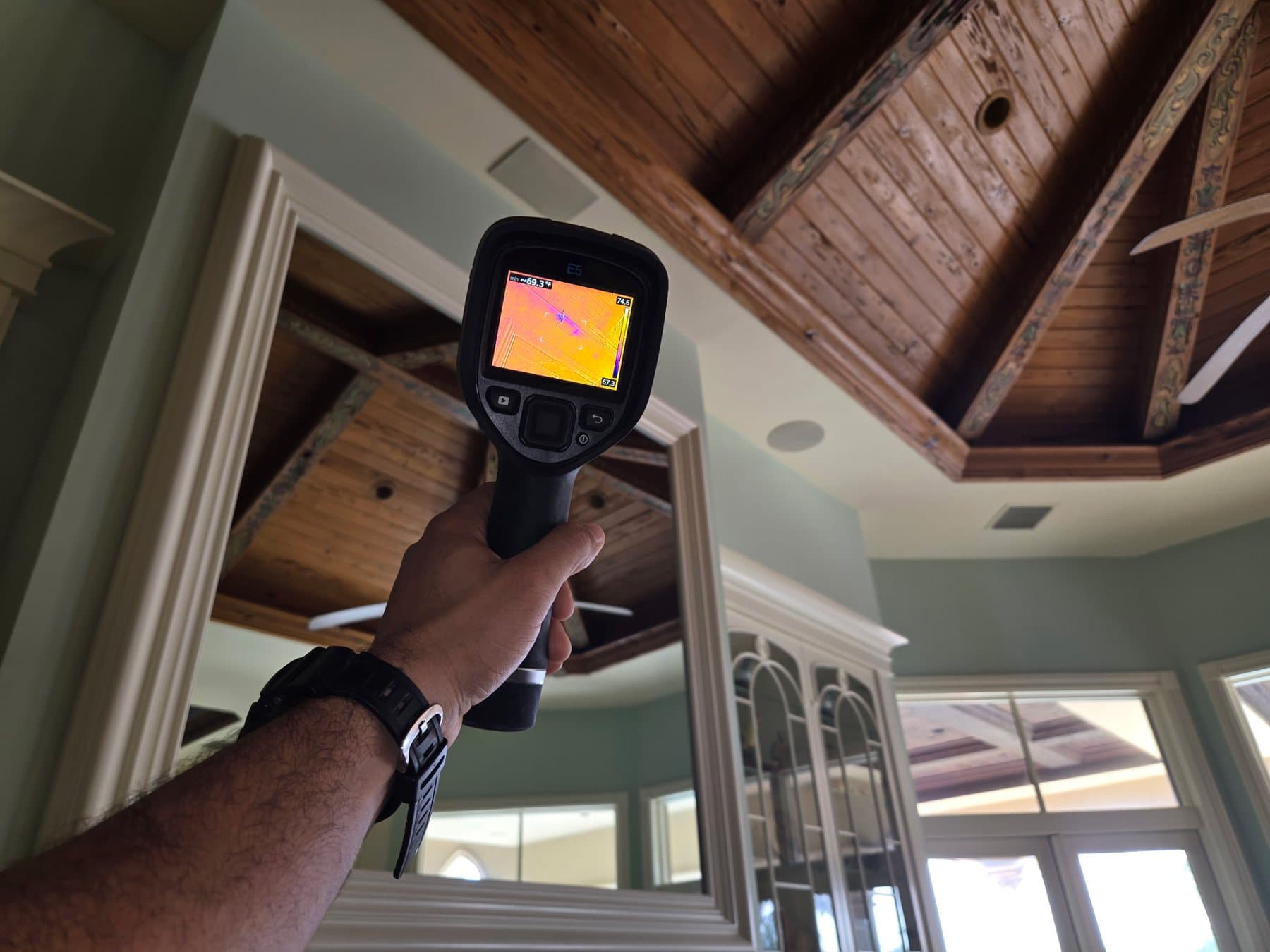
A blocked condensate line or an under-insulated air handler in an interior closet wets the surrounding drywall from the back side, so that closet gets opened and metered on every visit.
03
Roof Penetrations And Flashing
Vents, boots and flashing details let storm water into the ceiling assembly, and the stain that appears on the ceiling is often several feet away from where the water is actually entering.
04
Aging Stucco On Mid-Century CBS Homes
Hairline cracks in decades-old stucco and failed sealant joints on mainland block houses let water move behind the wall, where it stays damp in the gap between one storm and the next.
05
Laundry Rooms And Interior Bathrooms
These rooms make their own moisture, and a weak exhaust fan or a slow supply line leak raises the local humidity enough to support growth behind a vanity, a washer box or a baseboard.
Testing And Air Quality
Mold Testing & Air Quality In Vero Beach.
Mold Testing In Vero Beach
Air and surface samples from your Vero Beach property go to an accredited laboratory under chain of custody. The report names the species present, including Stachybotrys, the one most people mean by black mold, and gives the counts against an outdoor baseline. Certified results come back in 24–48 hours.
How Mold Testing WorksAir Quality Testing In Vero Beach
When the concern goes beyond mold, we test indoor air for VOCs, formaldehyde and bacteria, and run ERMI or mycotoxin panels when the result would change a decision. The plan is built on what the walkthrough found, not a shotgun panel.
See Indoor Air Quality TestingYour Mold Inspector, Never Your Remediator
Mold Shark is the licensed mold assessor in the process, not the cleanup crew. We do not perform mold removal or remediation in Vero Beach or anywhere else. If the property needs it, you take our written findings to any remediation company you choose, and we can return afterwards to verify the work.
Read This Before Hiring A RemediatorWhat We Run
Services Available In Vero Beach.
Also available in Vero Beach: HVAC Mold Inspection, Tenant & Landlord Reports, Black Mold Testing, Moisture & Thermal Imaging, Real Estate Inspections, Before Mold Remediation.
Questions
Vero Beach Questions, Answered.
No, and that is deliberate. Mold Shark holds both a Florida Mold Assessor license (MRSA3341) and a Mold Remediator license (MRSR3507), and still never performs remediation. That is a choice, not a limitation, and it is the whole reason our findings carry no conflict of interest. Under Florida Statute 468.8419 a licensed assessor may not remediate a structure they assessed within the previous 12 months. Holding the remediator license means we know what the cleanup actually involves and can read a contractor's scope and pricing properly. If the answer is a plumbing leak and no mold problem, that is what the report says.
Nearby
Close By, Same Standard.
Know What You're Breathing.
Certified inspection, lab-certified results in 24–48 hours. Independent. We never sell the repair.
FL Mold Assessor MRSA3341 · Testing Only · We Never Perform Remediation

- LAB RESULTS
- 24–48 HOURS
- TESTING HOURS
- Mon–Fri · 8:00am – 5:00pm
- CALL OR TEXT
- 7 Days A Week · 24 Hours
- COVERAGE
- 7 COUNTIES · TWO COASTS
- LICENSED
- FL MOLD ASSESSOR MRSA3341
- Google Maps
- 5.0 ★ · 86 REVIEWS